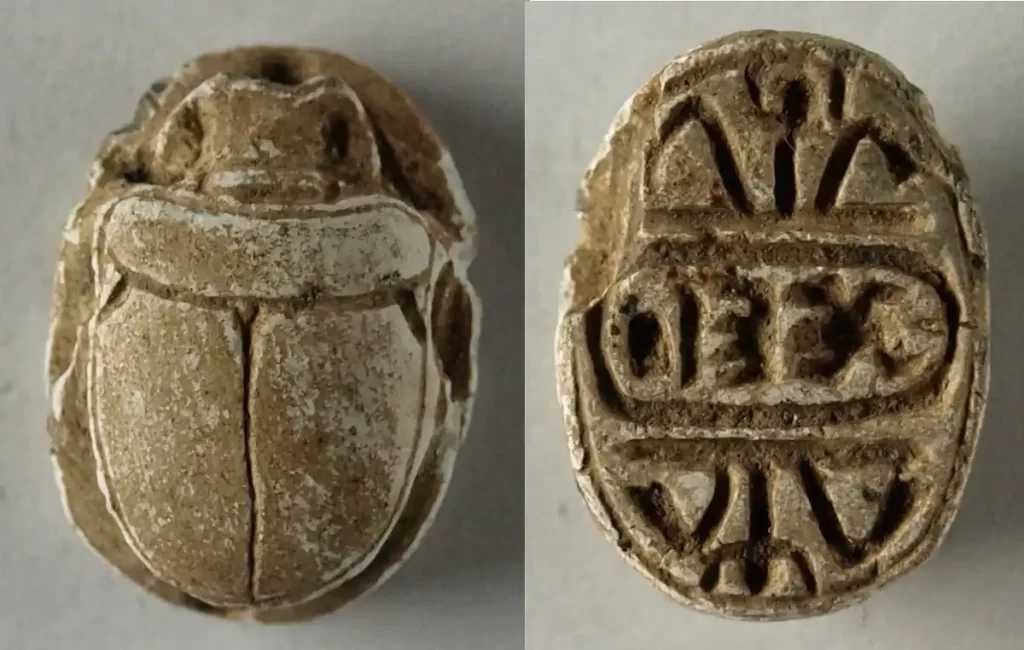
The Egyptian Scarab Beetle, which was depicted in Egyptian art, iconography, and ancient Egyptian religion, is one of the most significant symbols in the history of ancient Egyptian civilization. It stood for rebirth, resurrection, and vitality. Everything started when the beetle formed a ball out of its dung and placed its eggs inside. The dung served as food for the eggs’ larvae when they hatched, providing a wonderful metaphor for life emerging from death.
The sun deity Khepri, Ra’s servant who rolls the morning sun disc over the eastern horizon at dawn, became closely identified with the sign. The concepts of existence, manifestation, growth, efficiency and divine manifestation are all discussed in the scarab hieroglyph.
Egyptian Scarab Beetle Facts
The scarab of Egypt Whether made of stone or Egyptian faience, beetles were initially carved from glazed blue or green material before being burned. Steatite is the name of a soft stone that became hard when burned. Hardstone scarabs consisting of amethyst, green jasper, and carnelian were the most prevalent scarabs. The beetle emblem originated in the late Egypt Old Kingdom (2575-2130 BC) and took the form of an amulet, which was used throughout all of ancient Egypt. At the time, they were known as button seals.
They were incredibly uncommon, but by the time of the Egypt middle kingdom (1938-1630 BC), many of them had been made. They were used as ornaments and amulets, particularly in Egypt’s new kingdom (1539-1075 BC), where a large Scarab was inserted into the bandages of mummies to symbolize the deceased’s heart. The holy book of the dead contained numerous instances of the sign.
There were numerous clay sealings and the scarab appeared in the form of a seal. With a prayer like “With Ra behind There Is Nothing to Fear,” the Egyptian Scarab Beetle was employed to describe the titles of authorities, locations, and even other deities as a sign of good omen. The scarabs with royal names were the most expensive type in the 11th dynasty.
Due to the scarab collections that have been found, the names of the Hyksos dynasts have mostly been discovered. The scarab was brought to Europe by ancient traders from Mesopotamia, the Levant, and the Middle East. Even now, fake scarabs are still widely available.