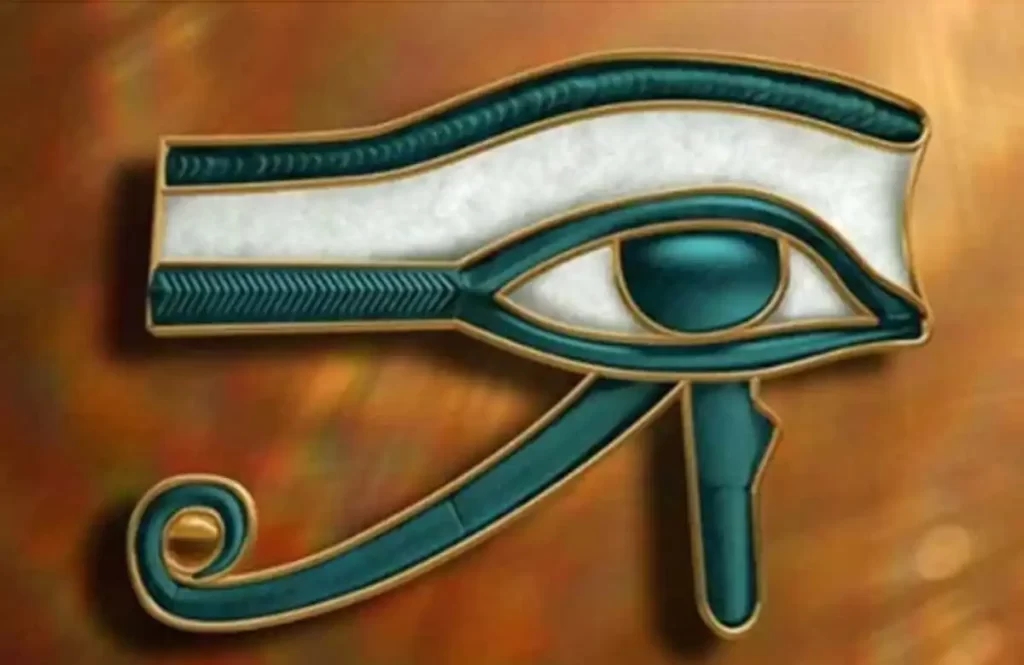
Eye of Horus
[ez-toc]
One of the most well-known representations of ancient Egyptian culture is the eye of Horus. It is known to represent royal strength, safety, well-being, rebirth, and victory. Other names for it include Wadjet, Wedjat, or Udjat, none of which should be confused with the Eye of Ra, which stood for many of the same ideas. Because of its potent protective properties, the eye of Horus was worn as a burial amulet by both the living and the deceased. Many ancient Egyptian sailors would paint the symbol on their ships to ensure a safe voyage at sea.
History of the Eye of Horus
The myth of Set and Osiris was created during the predynastic era, which is also when the eye of Horus first appeared. The ancient Egyptians held that a new age of darkness began to spread across the country when Osiris, the monarch of Egypt, was assassinated by his brother Set, the god of disorder, the desert, and war, using a diabolical slime. Isis, the wife of Osiris, used magic to resurrect her husband and bring him back to life, which caused her to become pregnant with Horus. However, Set later killed Osiris and dismembered his body into innumerable pieces. Horus was reared by his mother Isis and groomed to be a warrior so he might revenge on his father before Osiris became the ruler of the underworld.
When Horus reached adulthood, he engaged in a series of conflicts with his uncle and managed to prevail, but it cost him his eye. Another legend contends that Horus himself removed his eye as a sacrifice to raise his father from the dead. While many people believe Set tore his eye out, divided it into six pieces, and threw it away, this belief is not widely accepted. Later, his spouse Hathor, the goddess of beauty, joy, health, and love, or Thoth, the deity of wisdom, restored the eye. The Amulets of the Eye were used for both the living and the dead and were crafted of gold, lapis lazuli, and carnelian.
Significance of the Eye of Horus
As each of the six components of the eye is assigned a fraction as a unit of measurement, the eye of Horus also possesses mathematical knowledge. The teardrop is 1/64 of an inch in diameter, the curving tail is 1/32, the pupil is 1/4, the eyebrow is 1/8, the left side of the eye is 1/16, and the right side is 1/2. All of these fractions sum up to 63/64, and the omission is thought to either allude to Thoth’s wizardry and supernatural prowess or to the idea that nothing is completely flawless.
The right side of the eye is connected to the sense of smell since it is the closest to the nose and mimics the organ, in addition to the mathematical significance of each part. The eyebrow stands in for thought because it allows us to convey our thoughts, while the pupil is a representation of the sense of sight. Because it points in the direction of the ear and resembles a musical instrument, the left side of the eye represents the sense of hearing. Due to its resemblance to a sprout from a planted stalk of wheat or grain, the curving tail is a visual representation of the taste sensation.