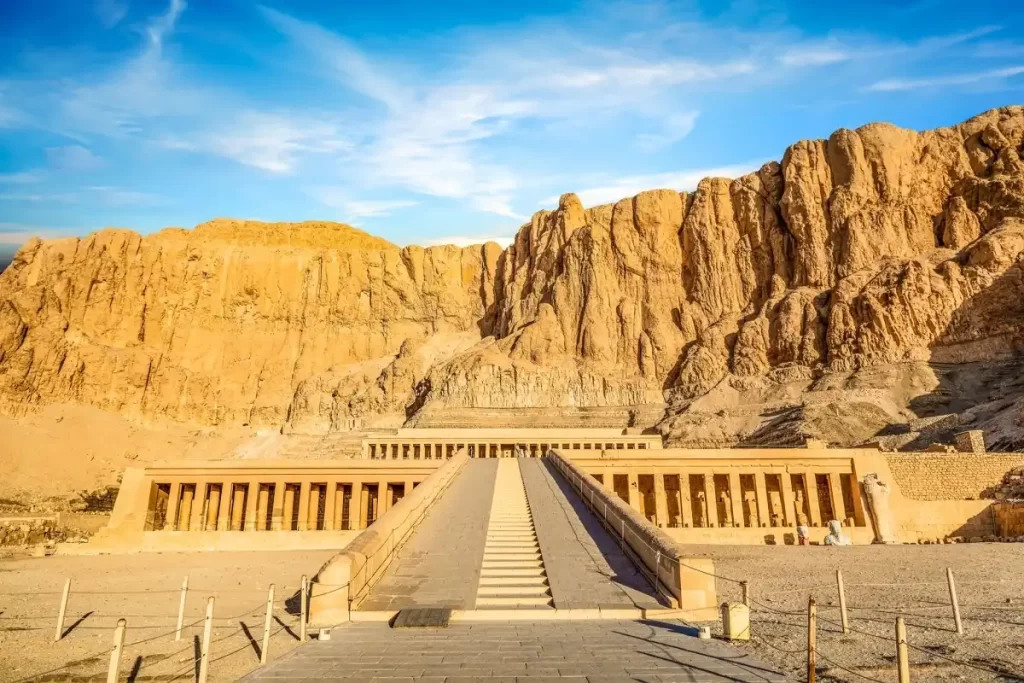
Queen Hatshepsut Temple
[ez-toc]
The Mortuary Temple of Hatshepsut (1479-1458 BCE)
Hatshepsut was the greatest pharaoh in the annals of ancient Egypt, and Luxor is gifted with a number of heavenly works of art that demonstrate the remarkable foundations upon which this great civilization was constructed. The temple of Hatshepsut is the best illustration of the magnificent architecture that was once present in ancient Egypt.
The Story Beyond the Mesmerizing Hatshepsut Temple
The Djoser-Djeseru (Holy of Holies), also known as the Hatshepsut temple, was constructed for the “Pharaoh Queen Hatshepsut” of the Eighteenth Dynasty. It is regarded as the pinnacle of ancient Egyptian achievement and is one of the most magnificent temples ever built. It is devoted to the life and times of Amun, the creator god, and Hatshepsut. The Egyptian king had a responsibility to respect their Gods and Pharaohs and to build temples and tombs to honor them and keep their legacy alive forever. The Mortuary temple met both of Queen Hatshepsut’s goals of immortalizing her name and improving her public image. The Egyptians forbade women from holding positions of power, therefore she governed for roughly twenty years in the likeness of a man. She was said to be the daughter of a very powerful god.
Short Description of Queen Hatshepsut’s Reign
The daughter of King Thutmose I and his wife Ahmose was Queen Hatshepsut. Thutmose I had a son with Mutnofret from a second marriage, known as “Thutmose II.” Hatshepsut wed Thutmose II before turning 20 in accordance with custom. The highest rank a woman can attain in Egypt and one that gives her a strong political position was Queen Hatshepsut’s elevation to that of the deity Amun’s bride. She managed the affairs of the realm as co-regent before being anointed Pharaoh of Egypt because her husband had died and his son was still a young infant.
In Egypt’s history, her reign was the most tranquil and wealthy. She is known for her prosperous trade, economy, and several public works initiatives that gave employees from all over the country jobs.
Where is the Hatshepsut Temple?
About 17 miles northwest of Luxor on the west bank of the river in western Thebes, the great capital of Egypt during the Egypt New Kingdom, is where you can find the Queen Hatshepsut temple. It is situated beneath the cliffs of “Deir El-Bahari,” a name derived from the former monastery constructed during the Coptic era (1550- 1050 BC). It is situated near Mentuhotep II’s mortuary temple and serves as the gateway to the Valley of the Kings, which you can explore while on a luxury Egypt tour.
The Design of Hatshepsut Temple
In 1479 B.C., Queen Hatshepsut granted the command to build this magnificent temple. She spent almost fifteen years building the temple that serves as a memorial to her life. Senenmut, the organizer of Hatshepsut, created the temple. He meticulously planned it in accordance with the Temple of Mentuhotep II, but he enlarged every single element.
The temple is three stories high, and each level perfectly depicts a colonnade. A garden containing exotic trees from Hatshepsut’s travels was once present on the Ground Level, but it has since vanished. There were colonnades with square pillars behind the courtyard. There are embellishments that show Lower Egypt’s marshes as well as Tuthmosis III standing in front of Amun. You can pass through archways to get to the upper level. Two sphinxes and reflecting pools may be found on the Second Level; they were lining the way to another ramp. One of the earliest visual records of a commercial expedition can be found there.
There is also a shrine dedicated to the goddess Hathor, who is seen holding a musical instrument and having a cow’s ears on her head. The punt colonnade, which is on the left side of the ramp and depicts Hatshepsut’s glorious expedition to the enigmatic “Land of the Gods,” which the Egyptians had not visited in centuries, is situated between the birth colonnade, which is situated on the right side of the ramp and tells the story of Hatshepsut’s creation with Amun.
A hypostyle hall with twelve gorgeous Hathor-headed columns and the Anubis Chapel, which features a hypostyle hall with twelve fluted columns and an astronomical roof, are also present. A portico with two rows of columns facing the front is located on the third level. King Tutmosis III portraits have taken the place of all Queen Hatshepsut depictions, which have been destroyed. Behind the courtyard is where you’ll find the Amun sanctuary. The Ptolemaic era saw its reconstruction and rededication to Imhotep.
The Historical Influence of Hatshepsut Temple
The most authentic temple in ancient Egyptian history is this amazing structure. It exalts the pharaoh and features shrines to deities important to her afterlife. The subsequent temples of the new kingdom are built similarly to this one.