Egyptian Mythology Afterlife and Judgment Story
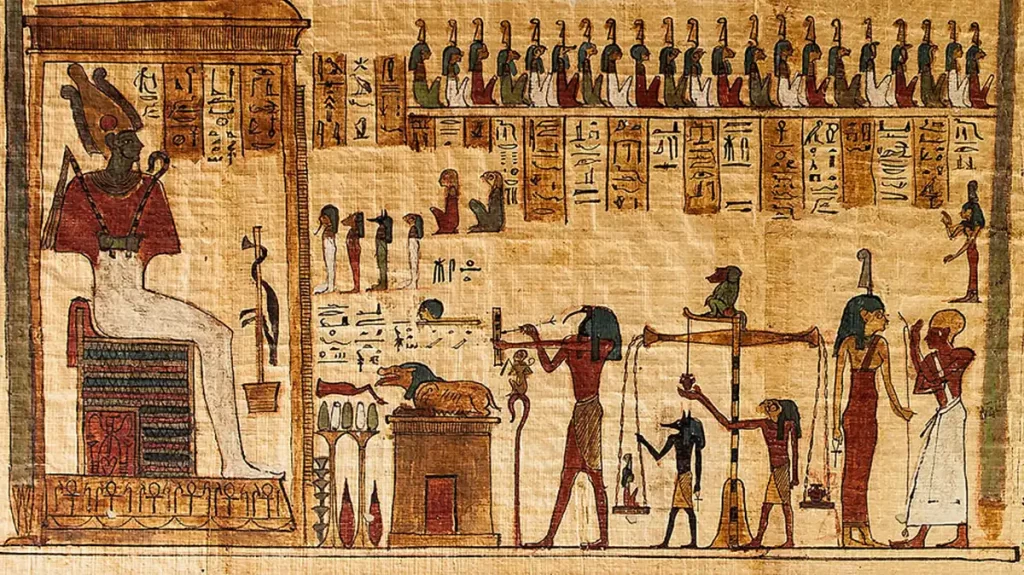
The ancient Egyptians held onto the concepts of repercussions and the continuation of life. The afterlife was one of the primary beliefs of the ancient Egyptians because they held that the soul is immortal and that the earth is but one stop on a grander journey and plan. The god of death Anubis would greet the deceased and lead them to their final resting place in the underworld before leading them to the hall of truth where they would wait their turn for judgment by the hand of the ruler of the underworld Osiris, according to their belief that the soul is composed of nine parts that were all a part of one earthly existence.
The Goddess of Harmony and Balance Ma’at would be present, surrounded by the forty-two judges, who would consult with the gods to determine each soul’s fate, and Anubis would lead the souls there when the moment was appropriate, in front of the golden scales, before the scribe of Thoth and Osiris. The Egyptians chose to preserve their body through the mummification procedure in case the soul decides to return to the body and proceed to the hereafter. This was done in order to prepare for the process of judgment.
The deceased’s heart, which holds the soul, is used to start the judgment process. Osiris then lays the heart on a large, golden scale and balances it against the white feather of Ma’at, also known as “the feather of truth.” If the heart was heavier than the feather, it would be cast into the deepest part of existence, where it would be devoured by the monster god Ammut who has the face of a lion. If the heart was lighter than the feather, it would be allowed to travel to the heavens known as the Field of Reeds (the place of purification and eternal bliss) by boarding the ship of Ra through the shadowy underworld.