The Djed Pillar
[ez-toc]
The Djed pillar, which stood for stability, permanence, and immutability, was one of the most well-known ancient Egyptian symbols. Throughout Egypt’s history, it could be seen everywhere in Egyptian art and architecture. The emblem actually portrays the god’s Osiris backbone and was connected to both Ptah, the God of Creation, and Osiris, the Ruler of the Underworld. The image has appeared frequently and vividly throughout Egyptian history to serve as a constant reminder to the populace of the nature of life, the fact that the gods are constantly nearby, and the fact that death is a gateway to a new beginning.
Djed Pillar Meaning
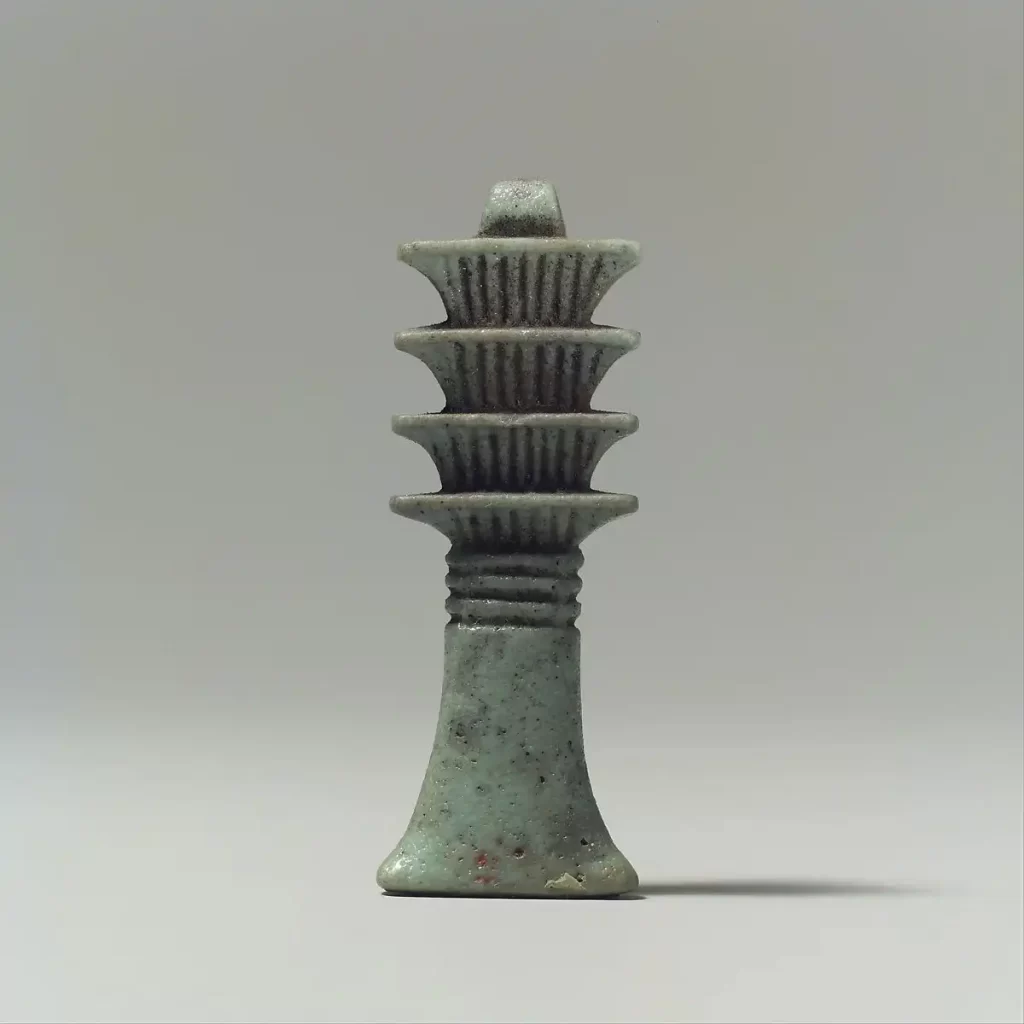
Near the top, the sign resembles a pillar or a vertical shaft with four horizontal bars and a sequence of lines separating each bar. Under the first horizontal bar, there are four bands around the shaft’s neck. The Djed pillar stands for the idea, the written and spoken word of stability. The symbol’s roots can be found in the Osiris myth, in which Osiris’s violent, disorderly, and chaotic brother Seth tricked him into getting into a coffin before throwing it into the Nile, where it eventually washed up on the shores of Byblos, where a sacred tree sprouted up quickly around the coffin.
The enormous tree amazed the ruler of the land, who ordered that it be cut into a pillar and placed in his palace empty; however, his wife, the goddess Isis, was able to obtain the pillar in order to remove Osiris’ body and reassemble the pillar, which later came to be known as the Djed Pillar. Ptah, the creation god, frequently appeared with the Djed and even referred to it as the honorable Djed. The Djed pillar symbolizes Osiris’ human spine, which would enable the soul to leave the body and travel to the afterlife and the gods’ enduring influence in one’s life.
Djed Pillar History
The Heb Sed “The Djed Pillar” Festival, which celebrated the first day of the harvest season by raising the pillar in the sky by the cult of Osiris, was held during the predynastic period. The pillar symbolized the grains rising from the earth like how Osiris returned from the dead. Osiris began as a fertility god before becoming the ruler of the underworld.
It was believed that the pillar of Djed supported the skies. The Djed was depicted on numerous temples throughout the Old Kingdom of Egypt (2613–2181 BC), appeared in various versions of the Book of the Dead, and even took the form of an amulet. The temple complex of the step pyramid of Djoser in Saqqara has one of the most notable examples of the Djed.