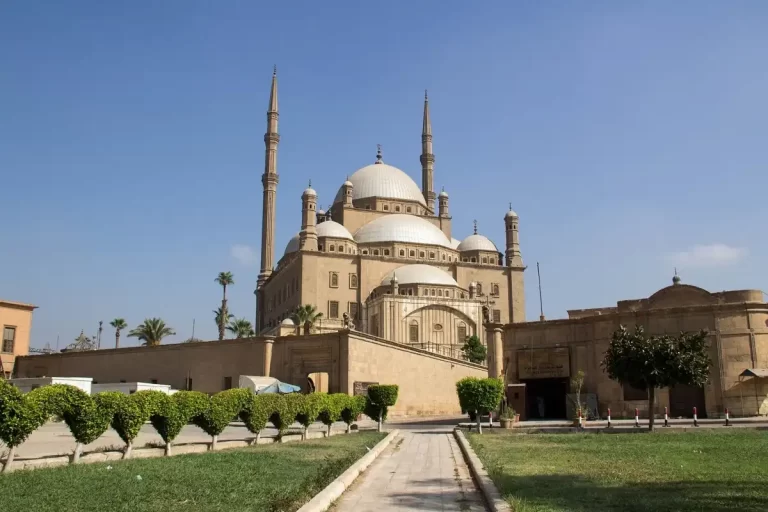
The Al-Rifai Mosque stands beside the Sultan Hassan Mosque below the Cairo Citadel and looks just as old, but it was completed in 1912. Built for the family of Khedive Ismail, it is the royal mausoleum of modern Egypt and the burial place of King Farouk and of Mohammad Reza Pahlavi, the last Shah of Iran.
- Location: Salah al-Din Square, opposite Sultan Hassan Mosque
- Built: 1869–1912
- Commissioned by: Khoshiar Hanim, mother of Khedive Ismail
- Style: Neo-Mamluk
- Time needed: 30 minutes
History
The site held a small shrine to Sheikh Ali al-Rifai, a Sufi saint. In 1869 Khoshiar Hanim, mother of Khedive Ismail, ordered a large mosque to replace it and to serve as a tomb for herself and her descendants. The architect Husayn Fahmi Pasha designed it, but work stopped for about 25 years and was finished by the Hungarian architect Max Herz in 1912. Its design was chosen to match its Mamluk neighbour, so the two mosques form one of the grandest squares in Cairo.
Royal Tombs
- Khedive Ismail, who built modern downtown Cairo and opened the Suez Canal.
- Khoshiar Hanim, the founder.
- Sultan Hussein Kamel and King Fuad I.
- King Farouk, the last king of Egypt, who died in exile in 1965.
- Mohammad Reza Pahlavi, the last Shah of Iran, buried here in 1980.
Architecture
The interior is richly decorated with marble, carved wood, gilded ceilings and inlaid metal, with the tombs set in rooms off the prayer hall. The two minarets and large dome balance those of Sultan Hassan across the street.
Visiting Tips
- A combined ticket often covers Al-Rifai and Sultan Hassan.
- Dress modestly and remove shoes in the prayer areas.
- Go up to the Citadel for a view down on both mosques.
Sheikh Ali al-Rifai
The mosque takes its name from Ahmad al-Rifai, a 12th-century Sufi saint from Iraq who founded the Rifa’i order, and from Sheikh Ali Abu Shubbak al-Rifai, a local holy man whose shrine stood on the site. Sufi gatherings and celebrations, known as mawlids, have long taken place around the tomb.
Royal Funerals
The mosque has hosted state funerals for members of the royal family. In 1980 the exiled Shah of Iran, Mohammad Reza Pahlavi, was given a state funeral in Cairo by President Sadat and buried here, beside his brother-in-law King Farouk’s family. His tomb is one of the most visited parts of the mosque.
A Square of Two Mosques
Standing between Al-Rifai and Sultan Hassan, you see more than 500 years of Islamic architecture face to face: the original Mamluk masterpiece and its 19th–20th-century echo. Look up at the Citadel above, and you have one of the grandest views in Cairo.
Visiting Hours
The mosque is usually open to visitors daily outside prayer times. Allow about 30 minutes, or an hour together with Sultan Hassan.
Islamic and Old Cairo Tours
- Islamic and Christian Cairo day tour – from $49
- Egyptian Museum, Citadel and Khan el-Khalili – from $49
- Egyptian Museum, Citadel and Old Cairo – from $49
- 2-day Cairo tour – from $277
- All Cairo day tours
Frequently Asked Questions about Al-Rifai Mosque
Who is buried in the Al-Rifai Mosque?
Members of Egypt’s royal family, including Khedive Ismail, King Fuad I and King Farouk, as well as Mohammad Reza Pahlavi, the last Shah of Iran.
How old is the Al-Rifai Mosque?
It was begun in 1869 and completed in 1912, although it was designed to look like a medieval Mamluk mosque.
Is the Al-Rifai Mosque old?
No. It looks medieval but was built between 1869 and 1912 in Neo-Mamluk style to match Sultan Hassan.