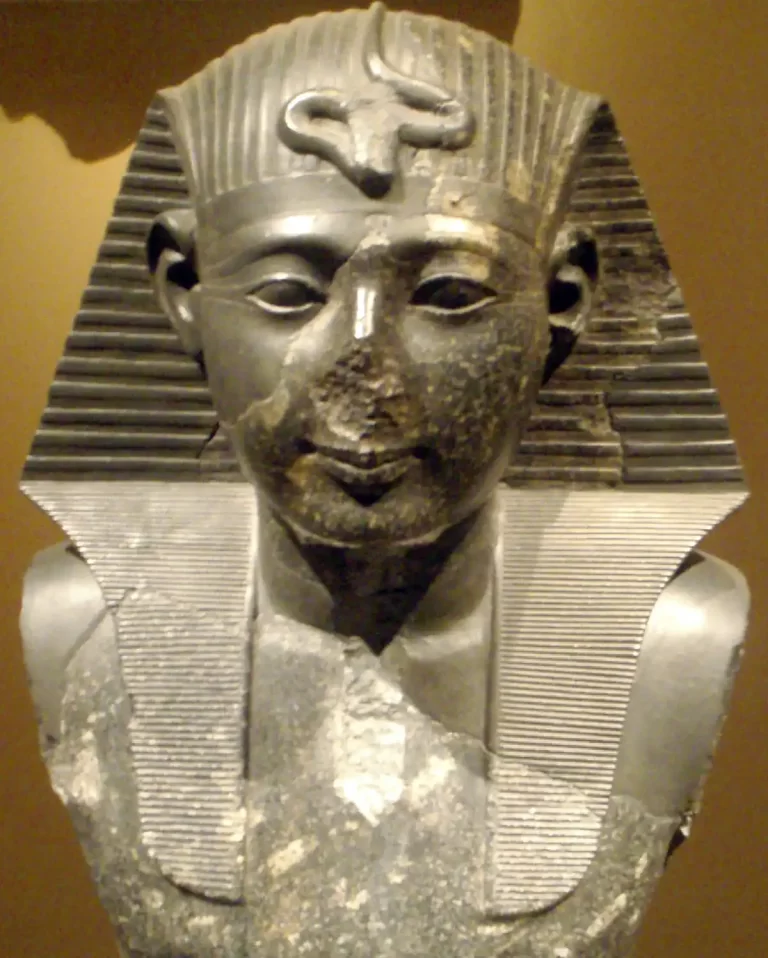
Tutankhamun is the most famous pharaoh in the world, not because of his reign but because of his tomb. He became king as a boy of about nine and died at around nineteen (c. 1323 BC). When Howard Carter found his almost intact tomb in 1922, its golden treasures made “King Tut” a global icon.
- Reign: c. 1332–1323 BC, 18th Dynasty
- Birth name: Tutankhaten, “living image of the Aten”
- Father: probably Akhenaten (DNA studies)
- Wife: Ankhesenamun, daughter of Akhenaten and Nefertiti
- Tomb: KV62, Valley of the Kings; found 4 November 1922
- Treasures: Grand Egyptian Museum, Giza
Life and Reign
Tutankhamun grew up during the religious revolution of Akhenaten, who replaced the old gods with the single sun disc, the Aten. After Akhenaten’s death, the young king and his advisers, the official Ay and the general Horemheb, restored the worship of Amun, reopened the temples and moved the court away from Amarna. He changed his name to Tutankhamun, “living image of Amun”. His Restoration Stela at Karnak describes a land where “the gods had turned their backs”.
How Did Tutankhamun Die?
No one knows for certain. CT scans and DNA studies have shown a broken leg that may not have healed, a club foot and evidence of malaria. Many scientists think a combination of infection, injury and inherited health problems caused his early death. Older theories of murder are not supported by the evidence.
The Discovery of the Tomb
Funded by Lord Carnarvon, the British archaeologist Howard Carter searched the Valley of the Kings for years. On 4 November 1922 his team found a step cut into the rock. When Carter first looked inside and Carnarvon asked if he could see anything, he answered, “Yes, wonderful things.” It took ten years to record and remove more than 5,000 objects. The deaths of Carnarvon and others led to the legend of the pharaoh’s curse.
The Treasures
- The gold mask: about 10 kg of gold inlaid with lapis lazuli, quartz and glass.
- Three nested coffins, the innermost of solid gold.
- Four gilded shrines that fitted around the sarcophagus.
- The golden throne, showing the king and queen in Amarna style.
- Chariots, weapons, games, clothes, jewellery and food for the afterlife.
The whole collection is now shown together at the Grand Egyptian Museum.
Visiting Tutankhamun’s Tomb
The tomb, KV62, is small compared with other royal tombs, but its burial chamber has well-preserved paintings, and the king’s mummy rests there in a climate-controlled case. A separate ticket is required.
See It on a Luxor Tour
- Luxor East and West Bank full day tour – from $39
- West Bank: Valley of the Kings and Hatshepsut – from $15
- Hot air balloon + Luxor full day – from $130
- 3-day Luxor tour package – from $329
- All Luxor day tours
Frequently Asked Questions about Tutankhamun
How old was Tutankhamun when he died?
About 19 years old, after a reign of roughly nine or ten years.
Where is Tutankhamun’s mummy?
In his tomb, KV62, in the Valley of the Kings in Luxor.
Where is Tutankhamun’s gold mask?
At the Grand Egyptian Museum near the Giza Pyramids, with the rest of his treasure.
Why is Tutankhamun so famous?
His tomb was found almost intact in 1922, with more than 5,000 objects, the richest royal burial ever discovered in Egypt.