The Catacombs of Kom el-Shuqafa are the largest Roman-era burial site in Egypt and one of the Seven Wonders of the Middle Ages. Cut deep into the rock in the 1st–2nd century AD, they mix Egyptian gods with Greek and Roman art in a way found nowhere else, a perfect picture of multicultural Alexandria.
- Location: Karmouz district, Alexandria
- Date: 1st–2nd century AD, used to the 4th century
- Discovered: 1900, when a donkey fell through the ground
- Depth: three levels, about 35 m down; the lowest is flooded
- Time needed: 45 minutes
Discovery
The name means “Mound of Shards”, after the broken pottery that covered the hill. In 1900 a donkey pulling a cart is said to have fallen into a shaft, revealing the tomb below. It was probably built for one wealthy family and later expanded for many burials.
What to See
- The spiral staircase: wound around a deep shaft used to lower bodies by rope.
- The rotunda and banquet hall: where relatives held funeral feasts.
- The main tomb: a shrine with columns in Egyptian style, guarded by statues of Anubis dressed as a Roman soldier, and a snake god wearing the double crown. Inside, the scenes show Egyptian funeral rituals carved in a Greco-Roman style.
- The Hall of Caracalla: a separate tomb linked by a passage, named after the emperor who is said to have massacred young men of Alexandria in 215 AD.
- Loculi: hundreds of burial niches cut into the walls.
Visiting Tips
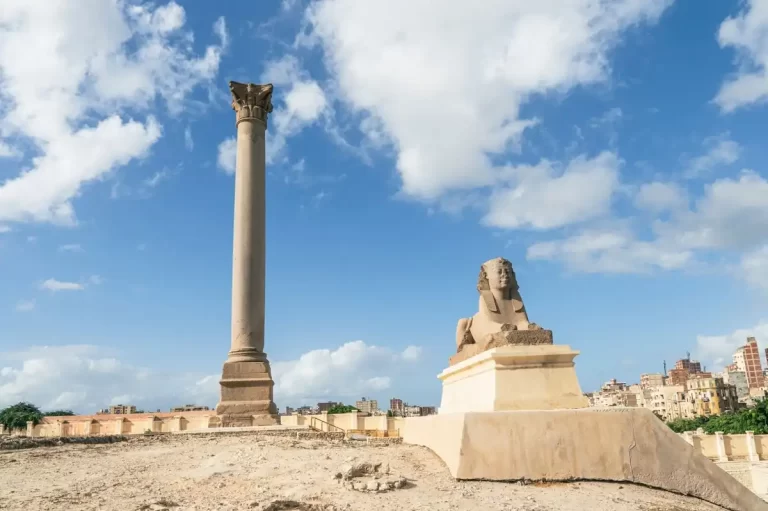
The steps are steep and the air is humid. Photography rules vary. Combine with Pompey’s Pillar, a few minutes away.
The Art of the Catacombs
In the main tomb, the doorway is decorated with a winged sun disc and Egyptian friezes, while the columns carry Greek-style capitals. Two serpents with the double crown and the caduceus of Hermes guard the entrance. Inside, reliefs show a mummy on a lion-shaped bed attended by Anubis, Thoth and Horus, in a classical carving style. Statues of the tomb owners show an Egyptian body pose with Roman portrait heads.
Who Was Buried Here?
The tomb was probably begun for a wealthy family who practised Egyptian religion while living in Greek-speaking Roman Alexandria. Later it was enlarged into a public cemetery with hundreds of niches for many families, used until the 4th century AD.
Practical Information
- Expect about 99 steps down the spiral staircase and a humid atmosphere.
- Comfortable shoes are essential; the lowest level is under water.
- The site also displays tombs moved from other parts of Alexandria in its courtyard.
Nearby
Pompey’s Pillar is a five-minute drive away; together they make a two-hour visit. Learn more about the city in our Alexandria travel guide.
Alexandria Tours
- Alexandria day tour: top attractions – from $45
- Day trip to Alexandria from Cairo – from $70
- Alexandria by night by horse carriage – from $29
- Alexandria shore excursion from the port – from $129
- 3-day Cairo and Alexandria package – from $499
- All Alexandria day tours
Frequently Asked Questions about the Catacombs of Kom el-Shuqafa
How were the Catacombs of Kom el-Shuqafa discovered?
In 1900, when a donkey reportedly fell into a hidden shaft, revealing the tombs below.
What makes the catacombs special?
They combine Egyptian, Greek and Roman art and religion in one tomb, such as Anubis dressed as a Roman legionary.
How deep are the Catacombs of Kom el-Shuqafa?
About 35 m below ground, on three levels; the lowest level is flooded with groundwater.